Poultry Care . Product Review
★★★★☆4.4 / 5Best for: small enclosed coops under 22 cubic feet
Affiliate disclosure
This article contains affiliate links. As an Amazon Associate I earn from qualifying purchases. If you buy through a link on this page I may receive a small commission at no additional cost to you. This never affects the price you pay or the opinions in this review.
Product overview

| Best for | Small coops up to 22 ft³ |
|---|
| Not for | Large barns or open runs |
|---|
| Power | 400W with remote control |
|---|
| Temp Range | 80–96°F adjustable |
|---|
| Bundle contents | Heater unit, remote, 6ft cord |
|---|
Worth buying: Owners of small, well-insulated coops who need precise temperature control between 80 and 96 degrees will find the remote and thermostat useful for overnight monitoring. The 400W output is sufficient for tight spaces but lacks the power for larger structures.
Not worth buying: Buyers with large poultry houses or drafty enclosures will find the 22 cubic foot limit restrictive and may experience inadequate heating during severe cold snaps. The lack of weatherproofing also makes it unsuitable for outdoor placement without shelter.
Check current price and availability on Amazon →Price and availability are subject to change. The link above is an affiliate link.
Overview and heating mechanism
This review examines a compact heating solution designed for small animal enclosures. The Flapiki unit combines a 400W heating element with a forced-air fan to distribute warmth evenly. Unlike passive radiant heaters that warm only the immediate vicinity, this model actively circulates air. The brand claims this approach prevents cold spots in confined spaces.
Winter chicken coop heater: how the fan changes heat distribution
Fan-forced systems move warm air faster than natural convection. This matters in winter when drafts can strip heat from birds quickly. The built-in fan pushes heated air across the enclosure volume. Users can adjust the target temperature between 80 and 96 degrees Fahrenheit using the included remote. The thermostat cycles the heater on and off to maintain this range. This automation reduces the need for manual checks during cold nights.
The unit includes a built-in light. This feature aids visibility when checking on poultry after dark. The remote controls both heating and lighting functions. A six-foot power cord offers flexibility in placement. The housing is enclosed to reduce direct contact with the heating element. Overheat protection shuts the system down if internal temperatures exceed safe limits. These safety features address common concerns about fire risks in bedding-heavy environments.
Battery operation is not supported. The device requires a standard electrical outlet. This limits use to coops with access to grid power or a generator. Solar setups would need an inverter capable of handling the 400W load. The manufacturer lists the product dimensions as 9 by 7.78 by 3.02 inches. Its weight is 1.54 pounds. This compact form factor allows mounting in tight spaces where larger heaters cannot fit.
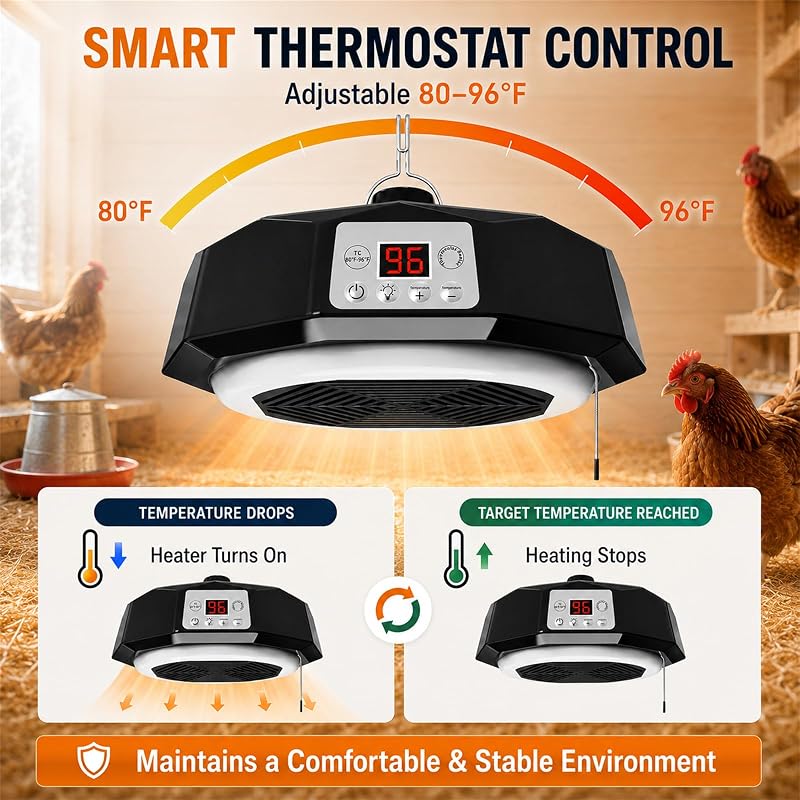 The compact housing fits easily into tight corners of small poultry shelters.
Specifications and capacity limits
| Feature | Detail |
|---|
| Heating Power | 400W |
| Temperature Range | 80–96°F |
| Max Volume | Up to 22 ft³ |
| Control Method | Remote control included |
| Cord Length | 6 feet |
| Best for small chicken coop heater spaces | Enclosed shelters only |
The 22 cubic foot volume limit is strict. A standard 4x4 foot coop with a 4-foot ceiling equals 64 cubic feet. This heater would struggle to warm such a space effectively. It suits brooders or very small hutches better than full-sized coops. Buyers must measure their enclosure volume before purchasing. Ignoring this limit leads to poor performance and higher electricity bills without adequate warmth.
Installation and safety routine
- Measure the enclosure volume to ensure it does not exceed 22 cubic feet. Calculate length times width times height in feet.
- Mount the unit on a wall at least three feet above the floor. This height keeps it out of reach of roosting birds and prevents bedding from blocking the fan intake.
- Plug the unit into a grounded outlet. Avoid using extension cords if possible. If an extension is necessary, use a heavy-duty gauge rated for 400W continuous load.
- Test the remote control from various points in the coop. Ensure the signal reaches the receiver without obstruction.
- Set the thermostat to 85 degrees Fahrenheit initially. Monitor the birds for signs of overheating or chilling. Adjust in two-degree increments based on their behavior.
- Inspect the power cord weekly for chew marks. Rodents and birds may damage the insulation. Replace the cord immediately if damage is visible.
Regular inspection prevents fire hazards. The overheat protection is a backup, not a substitute for proper placement. Keep the area around the heater clear of dust and feathers. Accumulated debris can block airflow and trigger shutdowns.
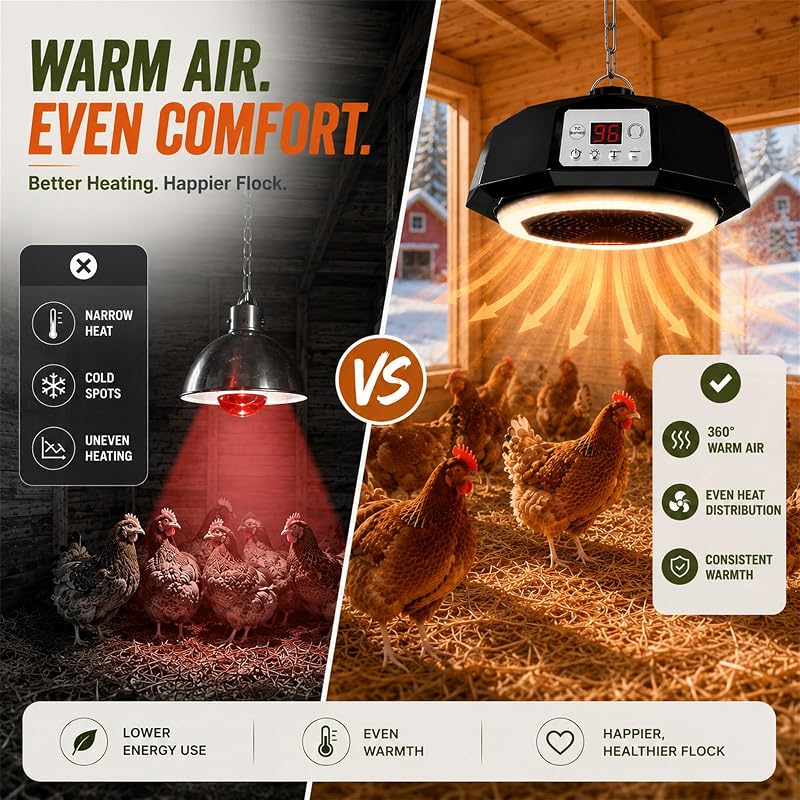 Mount the unit high on the wall to keep the cord away from curious birds.
Who should skip this heater
Large coop owners should look elsewhere. The 400W output cannot heat volumes larger than 22 cubic feet effectively. Drafty structures will lose heat faster than this unit can replace it.
Off-grid users face challenges. The heater requires mains power. Solar setups need substantial battery banks and inverters to run a 400W load continuously. This adds significant cost and complexity.
- Owners of large barns
- Users without reliable electricity
- Those needing weatherproof outdoor units
The plastic housing is not rated for direct rain exposure. It must be installed under a roof or in a sheltered area. Outdoor placement in wet climates risks electrical failure.
Pros and cons
Pros- Remote control allows temperature adjustment without entering the coop
- Fan forces warm air into corners
- Compact size fits tight spaces
- Overheat protection adds safety layer
- Built-in light aids night checks
Cons- Limited to 22 cubic feet; measure your coop volume before buying to avoid inadequate heating
- Requires mains power; off-grid users must add expensive inverters to make it work
- Plastic housing is not weatherproof; install only under cover to prevent rain damage
FAQ
Do you need a heater for a chicken coop in freezing climates?
Adult chickens often tolerate cold well if dry and draft-free. Heaters are mainly for chicks or extreme cold. This unit helps maintain a specific warm zone but is not essential for all flocks.
Can this heater run on solar power?
It requires 400W of continuous power. A solar setup needs a large battery bank and inverter. It is not plug-and-play for off-grid systems without significant additional equipment.
Is the remote control range sufficient for large coops?
The remote works well within line of sight. Thick walls or metal siding may block the signal. Test it from your intended control point before finalizing installation.
How often should I clean the fan intake?
Check weekly for dust and feather buildup. Blocked intakes reduce efficiency and trigger overheat protection. Use a soft brush to remove debris gently.
Buying advice
This heater serves a narrow but specific niche. It excels in small, enclosed spaces where precise temperature control is needed. The remote and thermostat offer convenience for owners who monitor their flock closely.
Buyers with larger coops or drafty structures will find the 400W output insufficient. The 22 cubic foot limit is a hard constraint that many standard coops exceed. Off-grid users should consider the power requirements carefully before purchasing.
For small brooders or insulated hutches with access to mains power, this unit provides a controlled warm environment. Its safety features and compact design make it a viable option for these specific scenarios.
Check current price and availability on Amazon →Price and availability are subject to change. The link above is an affiliate link.