Poultry Care . Product Review
Best for: enclosed coops up to 220 sq ft
Affiliate disclosure
This article contains affiliate links. As an Amazon Associate I earn from qualifying purchases. If you buy through a link on this page I may receive a small commission at no additional cost to you. This never affects the price you pay or the opinions in this review.
Product overview

| Best for | Enclosed coops up to 220 sq ft |
|---|
| Not for | Open-air runs or unventilated spaces |
|---|
| Heat Output | 1500W PTC element |
|---|
| Control | Remote and onboard panel |
|---|
| Bundle Contents | Heater, mounting hardware, manual |
|---|
Worth buying: Keepers with enclosed coops under 220 square feet who need reliable frost protection for water lines will find the 1500W output sufficient for severe cold. The wall-mounted design prevents litter contamination, though proper ventilation remains essential for flock health.
Not worth buying: Owners of large barns or open-air runs should skip this unit as the 1500W limit cannot effectively heat expansive or poorly insulated areas. Buyers requiring battery backup during power outages must look elsewhere since this model relies entirely on grid electricity.
Check current price and availability on Amazon →Price and availability are subject to change. The link above is an affiliate link.
Heating mechanism and speed
The Flapiki unit uses a PTC (Positive Temperature Coefficient) heating element. This technology allows the device to reach operating temperature in three to five seconds. Fast heat generation matters when temperatures drop suddenly overnight. The brand claims the 1500W output suits enclosed areas up to 220 square feet. This capacity aligns with standard small to medium-sized backyard coops. Larger structures will require multiple units or a different heating strategy.
PTC elements differ from traditional resistance wires. They self-regulate their resistance as they heat up. This characteristic reduces the risk of overheating compared to older wire-based systems. The unit cycles on and off based on the thermostat setting. It does not run continuously once the target temperature is reached. This cycling helps manage energy consumption while maintaining warmth.
Thermostat and control options
Users set the desired temperature between 60 and 90 degrees Fahrenheit. The thermostat monitors ambient air. When the temperature falls below the set point, the heater activates. It shuts off when the room reaches the target. This automation removes the need for manual adjustments during cold snaps. The remote control allows changes from outside the coop. This feature protects the keeper from entering a cold space just to adjust a dial.
A timer function offers additional control. Pressing the timer button adds one hour per press. The maximum schedule is 12 hours. This limit prevents the heater from running indefinitely if forgotten. Natural fan mode circulates air without heat. This setting helps disperse stale air and odors during milder weather. It does not replace proper ventilation but supplements it.
Safety considerations
Poultry environments present unique fire risks. Dust, feathers, and dry bedding accumulate quickly. The unit includes a 130-degree Fahrenheit overheat cutoff. This sensor stops the device if internal temperatures become unsafe. Wall mounting is mandatory for safe operation. Placing the heater on the floor exposes it to litter and curious birds. The brand specifies mounting height at approximately 3.2 feet above the floor. This elevation keeps the hot surface away from direct contact.
The listing mentions tip-over protection. This feature is less relevant for a wall-mounted unit but adds a layer of security if the mount fails. Waterproof ratings are not specified in the provided facts. Keeping electrical devices dry in a coop requires careful placement. Avoid installing near waterers or areas prone to condensation. The plastic housing resists minor moisture but is not submersible.
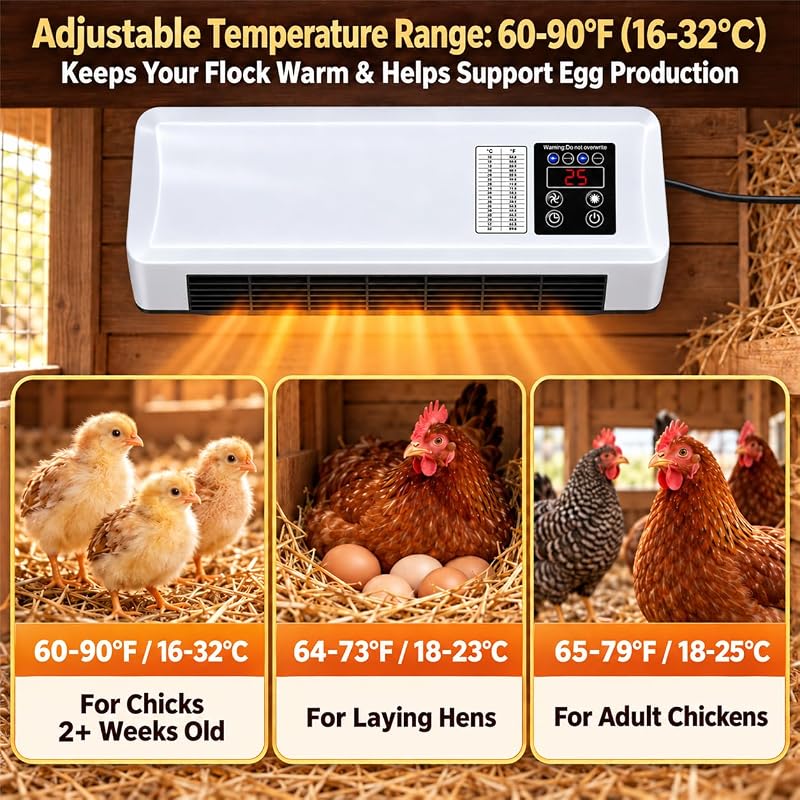 The wall-mounted design keeps the heater away from floor litter and direct contact with birds.
Pros and cons
- Fast 3-5 second heat-up time
- Remote control allows adjustment from outside
- Wall mount keeps unit off dirty floors
- Timer prevents indefinite operation
- Overheat protection adds safety layer
- 1500W limit restricts use to small coops; measure your space before buying
- No battery backup; power outage means no heat; consider a generator for severe climates
- Waterproof rating unspecified; install away from waterers to avoid electrical hazards
Technical specifications
| Feature | Detail |
|---|
| Power | 1500W |
| Heating Element | PTC Ceramic |
| Temperature Range | 60-90°F (16-32°C) |
| Coverage Area | Up to 220 sq ft |
| Control Method | Remote and Onboard Panel |
| Timer | 1-12 Hours |
| Mounting | Wall Mount Only |
| Safety Features | Overheat Cutoff, Tip-Over Protection |
| Dimensions | 17 x 7.2 x 4 inches |
| Weight | 1.45 kg |
Installation steps
- Select a wall location 3.2 feet above the floor. Ensure the spot is away from waterers and direct drafts.
- Mark the drilling points using the included template or by holding the mount against the wall.
- Drill holes for the expansion anchors. Use a bit size matching the anchors provided in the box.
- Insert the anchors into the holes. Tap them gently until they sit flush with the wall surface.
- Secure the mounting bracket with the provided screws. Ensure the bracket is level and tight.
- Hang the heater unit on the bracket. Connect the power cord to a grounded outlet.
- Test the remote control and thermostat settings. Verify the fan operates in both heat and natural modes.
 Mounting hardware includes screws and expansion anchors for secure installation on various wall types.
Pros and cons
Pros- Fast 3-5 second heat-up time
- Remote control allows adjustment from outside
- Wall mount keeps unit off dirty floors
- Timer prevents indefinite operation
- Overheat protection adds safety layer
Cons- 1500W limit restricts use to small coops; measure your space before buying
- No battery backup; power outage means no heat; consider a generator for severe climates
- Waterproof rating unspecified; install away from waterers to avoid electrical hazards
FAQ
Do I need a heater in my chicken coop?
Most adult chickens tolerate cold well if kept dry and draft-free. Heaters are primarily needed to prevent water from freezing or to protect young chicks. This unit helps maintain liquid water in temperatures below freezing.
Can this heater run continuously?
The thermostat cycles the heater on and off to maintain the set temperature. It does not run at full power constantly. The 12-hour timer also limits continuous operation if enabled.
Is the remote control range sufficient for large coops?
The listing does not specify the exact remote range. Infrared remotes typically require line-of-sight. Test the remote from your intended control position before finalizing the mount location.
What happens if the power goes out?
This unit requires mains electricity and has no battery backup. During an outage, the heater will stop working. Insulating the coop and using thermal mass can help retain heat temporarily.
How do I clean the heater?
Unplug the unit before cleaning. Wipe the exterior with a dry cloth. Do not use water or chemical cleaners near the electrical components or vents. Remove dust from the intake regularly.
Buying advice
The Flapiki 1500W heater provides targeted warmth for small enclosed coops. Its PTC element offers rapid heating while the thermostat prevents energy waste. Wall mounting addresses the critical safety issue of keeping electrical devices away from flammable litter.
Buyers with coops larger than 220 square feet should look for higher-capacity solutions. The lack of waterproof certification means installation location requires careful planning to avoid moisture damage. For standard backyard flocks needing frost protection, this unit delivers focused functionality.
Check current price and availability on Amazon →Price and availability are subject to change. The link above is an affiliate link.